
Instruments Found With Tipton County Deed Records
The Recorder preserves far more than simple sale deeds. Every instrument label matters. Warranty deeds, quitclaims, sheriff's deeds, and personal-representative deeds each signal a different route into the ownership chain, so read the parties, legal description, execution date, recording date, and prior references together.
| Recorded instrument | What it conveys | Why it appears |
|---|---|---|
| Warranty deed | Land with stated title covenants | A conventional sale or transfer |
| Quitclaim deed | Only the interest the grantor may hold | Family transfers or correcting an ownership issue |
| Corrective deed | Restates a prior conveyance with a correction | Name, description, or recording-reference repair |
| Personal representative's deed | Estate-held real property | A probate-authorized transfer |
| Sheriff's, tax, trustee's, or commissioner's deed | Title through a statutory or court process | Foreclosure, tax sale, trust, or judicial action |
Mortgages, assignments, releases, liens, easements, restrictions, plats, and vacations sit beside Tipton County deeds in the indexes. Not all of them convey ownership. Their references still explain burdens and changes affecting the land.
The Tipton County Recorder's Online Search Gap
The official Tipton County Recorder page lists the local office but did not provide a verified public grantor-grantee portal during research. No reliable live field list, online cutoff year, image price, or searchable sample instrument could be confirmed. That means a web-only search is incomplete.
Call the Recorder at (765) 675-4614 and ask what dates are searchable at the office, which names and document types can be queried, and how to request a plain or certified copy. Give the parcel's current owner, prior owner if known, legal description, date range, and likely instrument type.
| Needed search detail | What to provide | Status |
|---|---|---|
| Party | Grantor and grantee spelling variants | Office confirmation needed |
| Time | A bounded recording-date range | Online coverage not verified |
| Instrument | Deed, mortgage, release, lien, easement, or plat | Official recorder vocabulary available |
| Land | Legal description and parcel identifiers | Match against tax and map sources |
Building a Tipton County Grantor-Grantee Chain
A chain follows people through indexed conveyances. Start with the newest credible deed. Skip the tax-history date, and check that the legal description stays with the same tract as the names change.
- Find the current party as grantee on the acquiring deed and note the recording reference.
- Read the grantor, execution and recording dates, legal description, and prior-instrument clause.
- Search that grantor as an earlier grantee, using spelling and capacity variants.
- Repeat while the land description matches, logging gaps, corrections, estate transfers, and court-related deeds.
- Move to deed books and microfilm when the office index or current system stops.
- Grantor
- The party conveying an interest.
- Grantee
- The party receiving the stated interest.
- Chain of title
- The linked sequence of conveyances affecting one tract.
- Book and page
- A volume reference used for older recorded material.
- Instrument number
- A unique reference assigned when a document is recorded.
Tipton Deed Books Before the Digital Era
Tipton County was organized in 1844, and the Indiana State Library verifies local deed-index microfilm from 1844 through 1902 and deed records through 1901. Those holdings provide a real historical fallback even though the current Recorder's online cutoff remains unverified.
Consult the State Library Tipton County research guide and its microfilm inventory, then use an index entry to request the matching volume and page. Older probate order books, plats, directories, and newspapers can bridge a name or address gap, but the deed book remains the conveyance source.
Mortgages and Releases Beside Tipton County Deeds
Read a mortgage chain as its own sequence. The sequence runs mortgage, assignment, modification, release, or partial release. A lender name on a tax page proves nothing. It does not show whether an obligation is open or paid. If no release appears, search lender-name variants. Also search assignments, corrections, and court filings before drawing any conclusion. Keep the conclusion narrow. Say only what the deed records show. Let a title company or attorney judge whether another indexed reference or an unrecorded issue affects the tract.
Plats, Easements, and Restrictions in the Tipton Record
A deed's lot and block may point to a recorded subdivision plat. Rural land reads differently. Expect section, township, range, acreage, or metes-and-bounds language there. Follow every reference. Dedications, rights-of-way, drainage, easements, restrictions, replats, and vacations all matter. The Indiana State Library's Tipton County map and plat-book inventory covers historical material from 1962 through 2011, adding context that never replaces the recorded plat or a current licensed survey.
When a Tipton Court File Explains the Deed
Court files often explain unusual grantors. Foreclosure, quiet-title, partition, boundary, and probate cases can put a sheriff, commissioner, trustee, or personal representative on the deed. Search MyCase by name and date range. Legal reliance calls for a certified order from the Tipton County Clerk. MyCase has limits. It omits older cases and some documents. Treat the docket as a route to the file. Then match the order or sale to the Recorder instrument. Keep court dates and deed dates separate. A complaint date, judgment date, sale date, execution date, and recording date can all describe one transfer process. Party names may also change capacity, as when an individual becomes personal representative of an estate, so record each date and capacity carefully to avoid mistaking a docket event for the conveyance itself.
Requesting a Tipton County Deed Copy
The dependable route is the Recorder counter, a telephone inquiry, or a focused mail and Indiana APRA request when permitted. Pick the right copy. Plain copies suit ordinary reading. Certified copies carry official weight for formal use. Fees follow the county's current schedule, so ask how they are calculated and what payment and delivery methods the office accepts before sending anything. The county's essential recording requirements explain why a submitted instrument needs names, signatures, notarization, tax information, and a legal description. Meeting them records the deed. They do not validate its legal effect. Confirm every fee with the office before mailing payment.
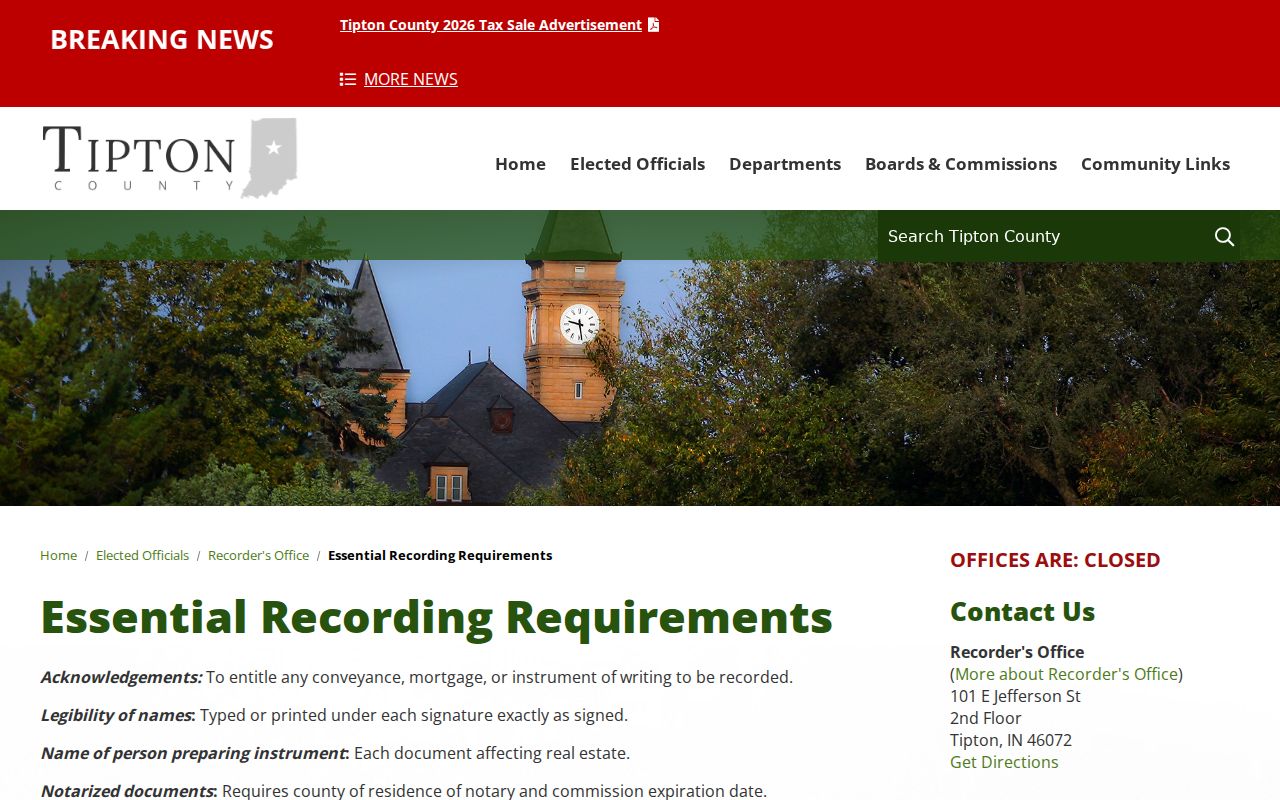
Read the live requirements before filing because county guidance can be revised.
Recorded is not guaranteed. Tipton County deed records show instruments accepted for recording, not a title opinion or every possible unrecorded interest.
Documenting a Tipton County Deed Search
A thorough search note records the exact party spellings and their capacities. It also lists the years covered, the instrument categories, and the recording references turned up in the index or book consulted. Say where the search stopped, too. Did online coverage for Tipton County property records prove uncertain? State that plainly. Name the Recorder inquiry used as the fallback. Honesty about limits beats a tidy but misleading summary.
Compare legal descriptions deed by deed, not just street addresses. Splits, combinations, replats, and partial conveyances can branch a chain. So can a reserved tract. Track the acreage, subdivision, lot, section, township, range, and prior-reference clauses on every instrument. When those details diverge, treat the documents as separate chains rather than forcing them into one.
Keep one last distinction clear. "No instrument found" is not the same as "no interest exists." The first describes a bounded deed records search. The second is a legal conclusion the public index alone cannot support. The gap matters most with old books, name variants, and incomplete online dates. It also arises with a release indexed under another party.