
Compare Tipton County Value Types
Indiana assesses real property at a 100 percent assessment level using a market value-in-use framework. That figure serves tax administration, not as a promise of what a parcel will sell for. Read every Tipton County property value next to its field label and its year.
| Value | What It Is | Where |
|---|---|---|
| Gross assessed value | Land and improvement assessment before deductions | Assessor and auditor detail |
| Taxable assessment | Assessment remaining after applicable deductions | Auditor and tax detail |
| Market value-in-use | Indiana assessment standard tested through ratio studies | Assessor and DLGF |
| Sale consideration | Reported transfer amount when applicable | Deed and sales disclosure |
Exemptions change the taxable assessment, never the underlying sale price. A related-party deed, non-market transfer, unusual financing, or changed condition can also make a single sale a weak benchmark for value.
Estimate Tipton Value From Records
Use the Tipton Treasurer search to find a parcel and its dated value history. Start with fewer search terms, since the portal warns that extra criteria can narrow the results.
- Match the address to APN, tax ID, map number, and legal description.
- Record land, improvement, gross, deduction, taxable, and history fields with the tax year.
- Check the recorded deed and post-July 2008 sales-disclosure route for sale evidence.
- Compare like property use, condition, date, and location before drawing a range.
- Assessed value
- The assessor’s value before or after deductions, depending on the precise field label.
- Market value-in-use
- Indiana’s standard for the value of property in its current use.
- Assessment ratio
- Sale price divided into assessed value for ratio-study analysis.
- Sale consideration
- The transfer amount reported when the conveyance represents a reportable sale.
Split Tipton Land and Improvements
County detail cards break land away from improvements. They then add a gross total and annual history. That split tells you whether a shift came from land, a building, or both. One industrial card also carries a TIF assessed-value field. Commercial records simply hold categories a home card never shows.
Treat a TIF field, a taxable assessment, and a deduction as their own numbers. Never set them beside a sale price as parallel estimates. Keep the label, tax year, class, and source with every figure. A blank street address is fine when the parcel number and legal description match.
Separate Tipton Deductions From Value
Homestead and supplemental standard deductions can reduce the taxable assessment shown on a residential card. They do not mean the building lost market value. The property-tax page owns the bill and appeal mechanics. This value comparison only marks where the numbers diverge.
A district rate also changes tax due without changing market value-in-use. Tipton City, Windfall, Sharpsville, and township-only districts have different components. Never infer that a higher tax rate proves a higher-priced property. For bills, deductions, and appeals, use the Tipton County property tax records.
Read Tipton Sale Evidence
A recorded deed backs up any transfer amount that reaches the Tipton County property records. Its sales disclosure supports that figure too. Indiana's statewide sales-disclosure form covers records from July 1, 2008 forward. Not every deed reflects an open-market sale, though. Estate, corrective, related-party, sheriff, trustee, and partial-interest deeds each demand their own reading.
Compare sales by date, use, condition, size, land mix, and location. A ratio study weighs groups of sales; it never appraises the subject parcel. When the record notes financing or family ties, use those facts. Fill in nothing the deed leaves out.
Track Tipton Annual Value History
The county's sample cards carry year-by-year value fields. A change in a line can trace to reassessment, new construction, demolition, or a correction. It can also trace to a classification shift, a split, or a combination. Keep the assessment year apart from the payable tax year. Indiana's current cycle began in 2026. It reviews roughly one-quarter of parcels annually, so nearby properties need not move on the same schedule.
The DLGF Tipton County page gathers the county-specific state material. The Assessor can confirm a parcel correction. Annual history shows recorded change, not the full story of why the market moved.
See Indiana’s Reassessment Source
For statewide context on Tipton County value updates, the official DLGF cyclical reassessment page is the state's own explanation of the schedule.
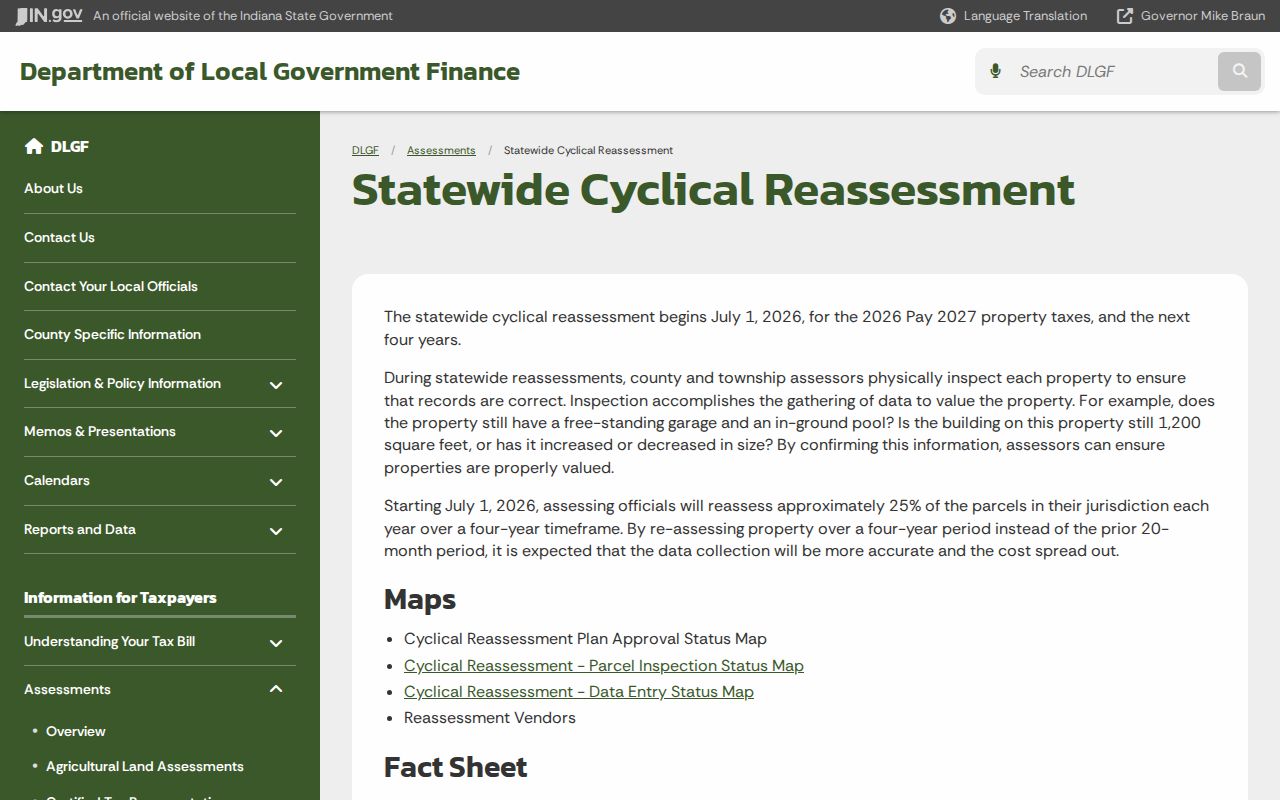
That state page separates a scheduled physical-review cycle from a parcel-specific sale or appraisal. The county record still controls the value and year shown for each parcel.
Know Tipton Assessment Limits
An assessor value comes from mass appraisal for tax administration. It cannot weigh every fact a buyer, seller, or licensed appraiser might inspect in person. The DLGF ratio-study guidance describes how the group-level test works. The cyclical reassessment program opened a new cycle on July 1, 2026. It reviews roughly one-quarter of parcels each year.
Value vs price. A Tipton County assessed value supports taxation. It is neither a sale forecast nor a licensed appraisal of one property.
Frame a Tipton Value Estimate
A sound estimate records property class, land area, improvements, condition date, and district. It also notes the effective date of each assessment or sale. A residential parcel should not sit beside an industrial warehouse. Both being in Tipton County does not make them comparable. The sampled industrial card separates land from improvements and carries TIF fields. That is exactly why labels matter.
Pull several relevant sales where you can. Then explain why they compare. One deed amount cannot capture condition, related-party terms, financing, partial interests, or work finished after closing. Ratio studies test groups, not one house. The county assessment still works as a public benchmark. But a licensed appraisal answers a parcel-specific market question.
A value concern does not automatically change a bill. Ask the Assessor about valuation, the Auditor about deductions and taxable assessment, and the Treasurer about charges. Appeal mechanics live on the tax-record route. Here the task ends at what each value means and where its record sits.
Date every comparison. A current assessment, an earlier deed, and a future payable tax year can sit side by side on one screen. Exact numbers tell the wrong story without dates attached to them. For each Tipton County property value, record the portal URL, parcel key, field label, effective year, and the date you accessed it.