
Three Views of Tipton County Property Tax Records
Tipton County splits property tax records across three offices. Each field reflects one office's snapshot.
Keep the payable year in mind as you compare them.
| Field | What It Shows | Where |
|---|---|---|
| Property characteristics and gross assessment | Land and improvement facts used in valuation | Assessor |
| Deductions and taxable assessment | Adjustments applied to the assessment roll | Auditor |
| Tax district and rate context | Units that contribute to the levy for that parcel | Auditor and Treasurer |
| Installments, charges, payments, and balance | Account activity for the selected tax year | Treasurer |
| Warning or sale-status clues | Flags requiring direct office confirmation | Treasurer |
Indiana assesses property under a market-value-in-use framework. That figure is not a sale price, a deed consideration, or a private appraisal. Deductions can drop the taxable assessment far below the gross assessment on the same parcel.
Search Fields on the Tipton Treasurer List
The public search screen takes a Property or Parcel Number, a Name, a Property Address, or a Tax Year. Less is more here. Enter only a surname if a full address misses, and call the office for parcels that were recently split or combined.
| Key | Best use | Check before relying |
|---|---|---|
| Parcel number | Exact account matching | Format and leading zeros |
| Name | Broad parcel discovery | Entity and trust variants |
| Address | Known situs | Blank or changed street fields |
| Tax year | Bill-period selection | Payable year versus assessment year |
Begin at the official Tipton County Treasurer site map, which opens the searchable tax roll. Its output carries a “Not for Official Use!” label, so confirm any payoff amount or sale status with the Treasurer's office before acting on it.
Gross and Taxable Assessment in a Tipton Record
One residential record in Tipton County showed a gross assessment of $125,800. After deductions, the taxable assessment came to $46,680. That gap matters. Copy a single figure out of context and you misstate the actual tax base. A property is worth one amount on paper. It is taxed on another. The deduction lines explain most of the difference between the two.
Keep land, improvements, the gross figure, every deduction, and the taxable total on separate rows. Check the year attached to each number. A sample from one parcel is never a county-wide norm.
- Assessed value
- The Assessor's value under Indiana's assessment framework.
- Taxable assessment
- The amount left after applicable deductions.
- Levy or tax rate
- The rate created by the parcel's taxing units.
- Tax lien
- A claim arising from unpaid property tax, subject to official confirmation.
Reading a Tipton County Tax Bill Step by Step
A Tipton County tax bill lookup should lock in both identity and time. Match the account to the legal description and the district before reading any charges or balance as final.
- Search with one short key and select the intended tax year.
- Match parcel, owner, address, and legal-description clues.
- Read spring and fall charges, payment entries, balance, and warnings.
- Compare deductions and taxable assessment with the Auditor or Assessor view.
- Ask the Treasurer to confirm delinquency, payoff, redemption, or pending sale status.
- Assessment year
- The period tied to the property's valuation.
- Payable year
- The year in which the resulting tax is billed.
- Installment
- One scheduled part of the annual bill.
- Tax district
- The combination of taxing units assigned to the parcel.
Tipton County Districts Change the Bill
Two Tipton County parcels can carry equal gross assessments yet land on very different tax bills. Municipal rates, township levies, school funds, deductions, and other taxing-unit details all shift the total. In the 2025 payable 2026 table, Tipton City sat at 3.537500, Windfall Town at 3.163000, and Sharpsville Town at 2.764600, with township-only rates running near 1.46 to 1.55.
Check the current county tax-rate table against a real parcel and year. A higher rate alone says nothing about whether one property is better than another.
Tipton's 2026 Cyclical Reassessment
Indiana's statewide cyclical reassessment starts July 1, 2026. It affects taxes payable in 2027. Roughly one quarter of parcels get a physical inspection each year. The inspections rotate under the state's rolling cycle. The DLGF reassessment guidance lays out how the schedule works for Tipton County owners.
Preparation beats reaction. Date your photographs, sketches, sales evidence, and any correction requests now. When the next notice arrives, compare it line by line with the actual property facts.
The official state reassessment page displays the full timeline for the cycle.
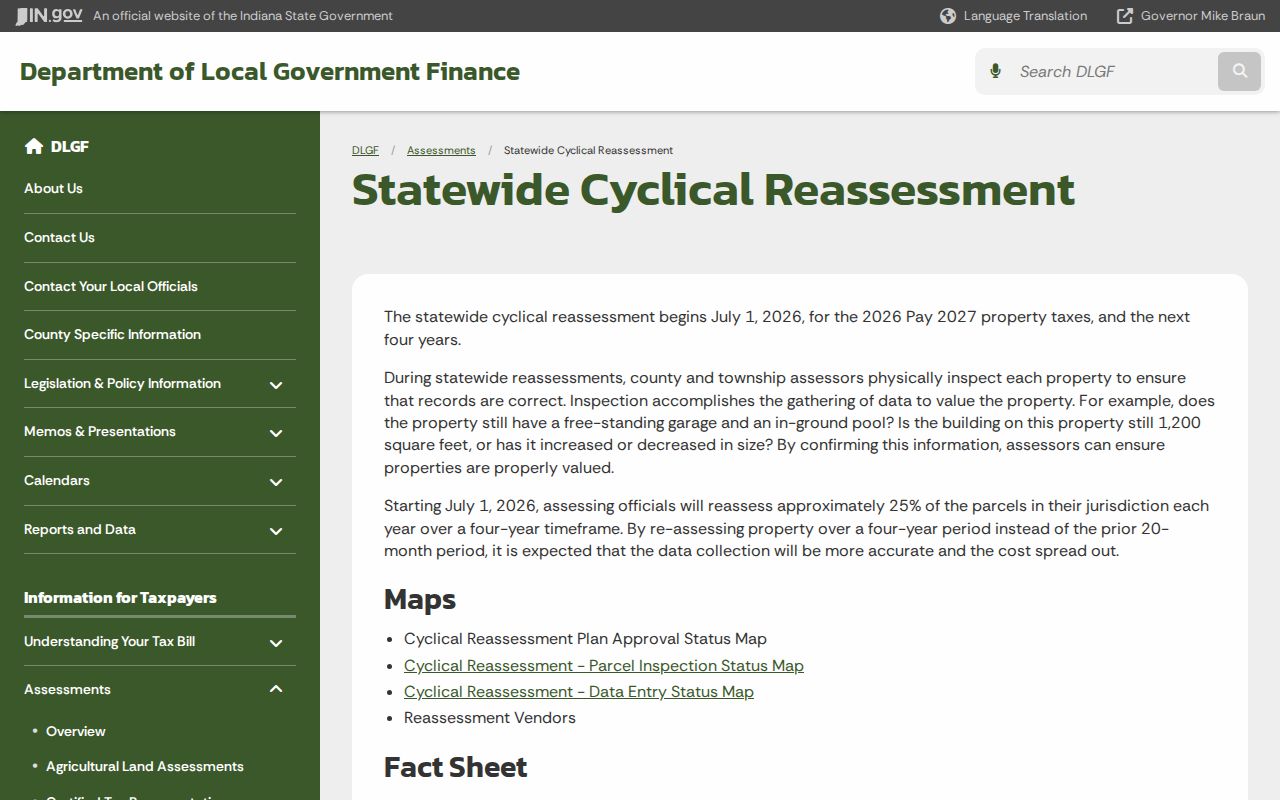
Match the parcel's notice to the live state rule.
Delinquency and Tipton County Tax-Sale Records
A warning flag is one thing. So is an overdue balance. An advertised parcel sits a step beyond both, and a sale result or a redemption changes the picture again. Tipton County published a 2026 tax-sale advertisement, but the current Treasurer and sale authority decide what a named parcel's status really is, whether it remained eligible, went to sale, or was redeemed.
Tax-sale records never replace deed, lien, or court research. Preserve the publication date and the parcel key, then check the Treasurer, the Recorder, and any relevant court record before drawing a title conclusion.
Payments, Installments, and Warning Flags
The Treasurer's detail page can show spring and fall amounts, charges, payments, balance information, and warning fields. Read the whole account. One blank or zero is not proof of payment. A payment may post after a screen was saved, and a warning may call for staff interpretation.
For a time-sensitive payoff, give the Treasurer the parcel number, owner name, property address, and tax year. Ask what sits outside the public display. Later charges, penalties, bankruptcy treatment, sale costs, and redemption figures may not appear there. Record the office name, date, and scope of confirmation.
Prior-year screens show account history. They do not replace an official receipt or a current payoff, so keep the bill date and the portal update date separate from the assessment date itself.
Deductions in Tipton County Property Tax Records
A deduction changes the taxable assessment, not the recorded sale consideration. Review every named deduction on the Auditor record. Confirm it belongs to the right parcel and year. Eligibility never transfers from a neighboring parcel or a prior owner's account.
The owner should ask the Auditor directly. Ask which current form applies. The office can state the required evidence, the filing date, and the occupancy or ownership rule, since state guidance changes and the Auditor publishes no complete Tipton-specific deduction form inventory. A missing or changed deduction can be a record-correction question, distinct from a challenge to the underlying assessed value.
Contesting a Tipton County Assessment
Start with the Form 11 notice. Then request an informal conference with the county Assessor before anything else. That conversation resolves many disputes. If it does not, Indiana's formal route runs through Form 130 and the Property Tax Assessment Board of Appeals. The Indiana Board is available for further review when applicable. Bring evidence that questions the property's recorded characteristics or comparable market data. A tax bill that simply feels too high is not grounds for an appeal.
Protect the deadline. Indiana guidance uses a June 15 filing rule in the stated circumstances; confirm the deadline on the notice and with the Tipton County Assessor.
Strong evidence makes a Tipton County appeal land better. Dated photos help, as does a property sketch. Comparable sales and proof of factual errors matter too. So does the notice under appeal. Keep a copy of everything filed, along with the delivery date. The DLGF property-tax appeals page is the state's starting point. The Tipton County Assessor confirms local filing details.
Know which office owns your problem. An appeal of value and a correction of a tax bill are different tasks. The disputed fact may sit in the Assessor's property record. It may sit in the Auditor's deduction and calculation work. Or it may sit in the Treasurer's payment account. A broad question sent to all three offices tends to draw partial answers. So name the exact field and year instead. That gives the custodian a clear issue to review.